

Brief
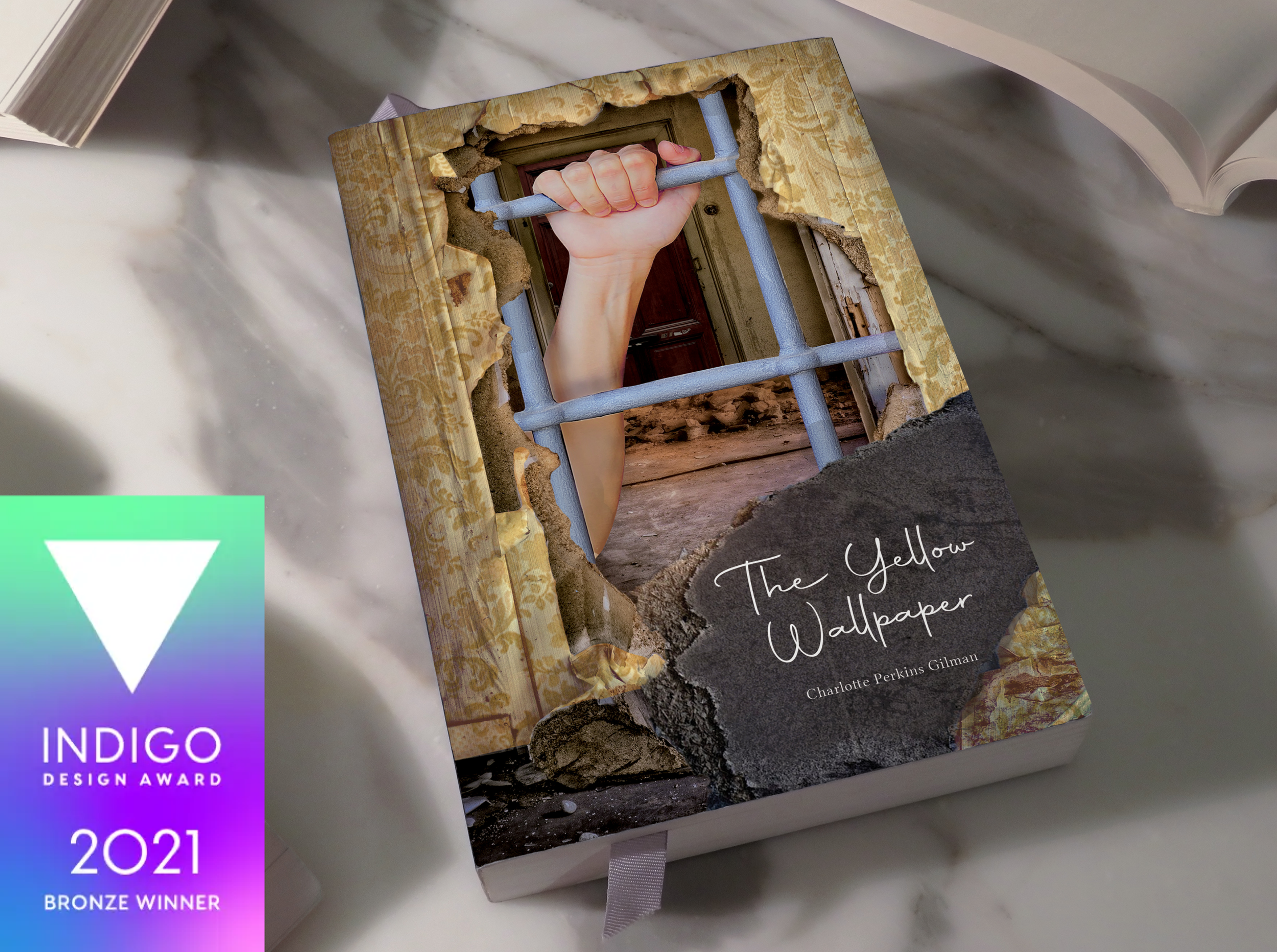
A book cover redesign for one of literature's most psychologically complex texts. The real brief wasn't how to make it look good, but how to make the reader feel what the protagonist feels before they've read a single word.
Industry
Editorial / Literary Design
Scope
Book cover concept, layout design, typographic treatment
Recognition
Indigo Design Award — Bronze, 2021 VIEW LINK
My Role
Designer & Narrative Interpreter
Deliverables
Full cover design including front, spine concept, and typographic system
1
The situation
Charlotte Perkins Gilman's The Yellow Wallpaper was published in 1892 and has never stopped being relevant. It's the story of a woman prescribed "rest cure" by her doctor husband — forbidden from writing, from thinking, from anything that might constitute an inner life — who slowly loses her mind inside a room with yellow wallpaper she becomes obsessed with.
Most book covers treat it as a period piece: decorative wallpaper patterns, Victorian typography, something that signals "classic literature." The problem with that approach is that it aestheticises a story about suffocation. It makes comfortable something that is meant to be deeply uncomfortable.
2
The real problem
The challenge of designing for a text like this is the same challenge the text poses to its reader: how do you make visible something that is deliberately being suppressed?
The narrator of The Yellow Wallpaper is not allowed to write. Her experience of confinement, her deteriorating grip on reality, her desperate need to express herself — all of it exists beneath the surface of a narrative she can barely articulate. The story works because the reader feels the pressure of what cannot be said.
A cover that decorates this story misses it entirely. The cover needed to make the reader feel, before opening the book, what it is to be trapped inside something that is slowly closing in.
3
The process
Two decisions drove everything.
The first was the prison-bar motif. The wallpaper in the story isn't just wallpaper — it becomes the protagonist's bars, her cage, the physical manifestation of every constraint her life has imposed on her. Rendering the pattern as vertical bars rather than decorative surface was a choice to name what Gilman was saying directly: this is a story about imprisonment. The bars belong on the cover.
The second was the typography. The narrator's defining characteristic — and her defining tragedy — is that she is a writer who has been forbidden to write. She writes anyway, secretly, in a journal. Her handwriting is her resistance. Using a hand-written typeface for the title wasn't a stylistic choice. It was a narrative one: the author's name and title rendered in the hand she wasn't supposed to use. The cover itself becomes an act of defiance.
4
What this piece demonstrates
Book cover design is where literary interpretation and visual thinking meet. Getting it right requires reading the text closely enough to understand what it's actually doing — not just what it's about, but how it creates its effect, what it's asking the reader to feel, and where the tension lives.
That's the same skill I bring to brand work. Before I make anything visible, I read the story underneath. What is this brand actually saying? What is it trying to say? Where's the gap? The Yellow Wallpaper cover is a demonstration of that instinct applied to one of the most psychologically layered texts in the literary canon.
Note: Self-initiated concept project

